
Artificial intelligence is rapidly creating new opportunities to expand services, reach communities, and support people at scale. For organizations working in economic inclusion, the challenge is figuring out how to apply AI in ways that are practical, responsible, and improve people’s lives.
How can these tools help people put new knowledge into practice? How do we make sure they are accessible and relevant? And how can we understand whether they are contributing to better livelihoods?
These questions came up during the first “Tools in the Field” session, organized through the Digital Innovations for Economic Inclusion Working Group (DSG Hub), in collaboration with Trickle Up. I had the opportunity to moderate the discussion, which featured Bailey Klinger from Hacer Perú sharing experiences from MAIA, a WhatsApp-based AI coaching tool for microentrepreneurs.
The discussion explored not only what AI can do, but also what it takes to make AI genuinely useful for people who are navigating real economic challenges.
1. Designing Technology Around People’s Needs
One important question is how AI can move beyond providing information to helping people put it into practice. For a microentrepreneur, knowing that tracking daily expenses is important is one thing. Finding the time to maintain those records while running a business and managing household responsibilities is another.
Coaching-oriented AI tools can help bridge this gap by identifying priorities, suggesting practical actions, and following up. Bailey shared how MAIA uses this approach, with nearly half of its conversations initiated by the tool itself.
Accessibility matters, too. MAIA operates through WhatsApp, allowing participants to use a familiar platform and communicate through text, voice message, or photographs. Its guidance is also adapted to local business contexts. Ultimately, technology needs to reflect people’s habits and capabilities. A sophisticated tool has limited value if it does not fit the realities on the people it is intended to support.
2. Measuring What Matters: From Engagement to Outcomes
It is relatively easy to measure how many people use a digital tool or how frequently they interact with it. What is harder to understand is whether those interactions make a different in people’s lives.
During the session, Aude de Montesquiou from Trickle Up raised an important question about measuring whether participants act on AI-generated recommendations and how those insights from conversations can inform program improvements.
Bailey explained that Hacer Perú tracks whether entrepreneurs implement suggested actions and examines how those behaviors relate to business outcomes, including changes in sales and costs. At the time of the session, the platform had supported more than 18,000 businesses and exchanged approximately 1.5 million messages.
One interesting finding was that more engagement does not necessarily lead to better outcomes. We learned that benefits increase up to a certain level of interaction, beyond which additional conversations do not necessarily produce greater financial improvements.
High usage may indicate that people find a tool useful, but it does not tell us whether their businesses are becoming more sustainable or their economic circumstances are improving. We need to look beyond engagement figures and consider what actually changes for participants.
3. Making Responsible AI Part of Program Delivery
Organizations also need to consider how they manage the risks of AI, particularly when participants may rely on its recommendations to make business decisions. During the discussion, I asked Bailey about selecting AI models, balancing cost and accuracy, and managing digital hallucinations that could result in incorrect information being shared with participants.
He described how MAIA uses a testing dataset of approximately 1,500 questions drawn from real-world interactions, alongside different AI models and verification mechanisms to reduce inaccurate responses.
For nonprofit organizations, implementing AI responsibly requires ongoing testing and oversight, not simply selecting a model. Organizations also need to consider data protection and accountability, particularly when introducing tools that interact directly with participants.
4. Keeping Human Relationships at the Center
An important question for economic inclusion is how technology can complement existing support without replacing the people who provide it. Human coaches bring trust and an understanding of participants’ circumstances that technology cannot fully replicate. AI can extend support between coaching visits or provide guidance when a coach is not immediately available, but there are parts of the human coaching relationship that AI cannot perform. Because of that, it’s important to ensure that any AI tools complement the human relationships important for business rather than detract from them.
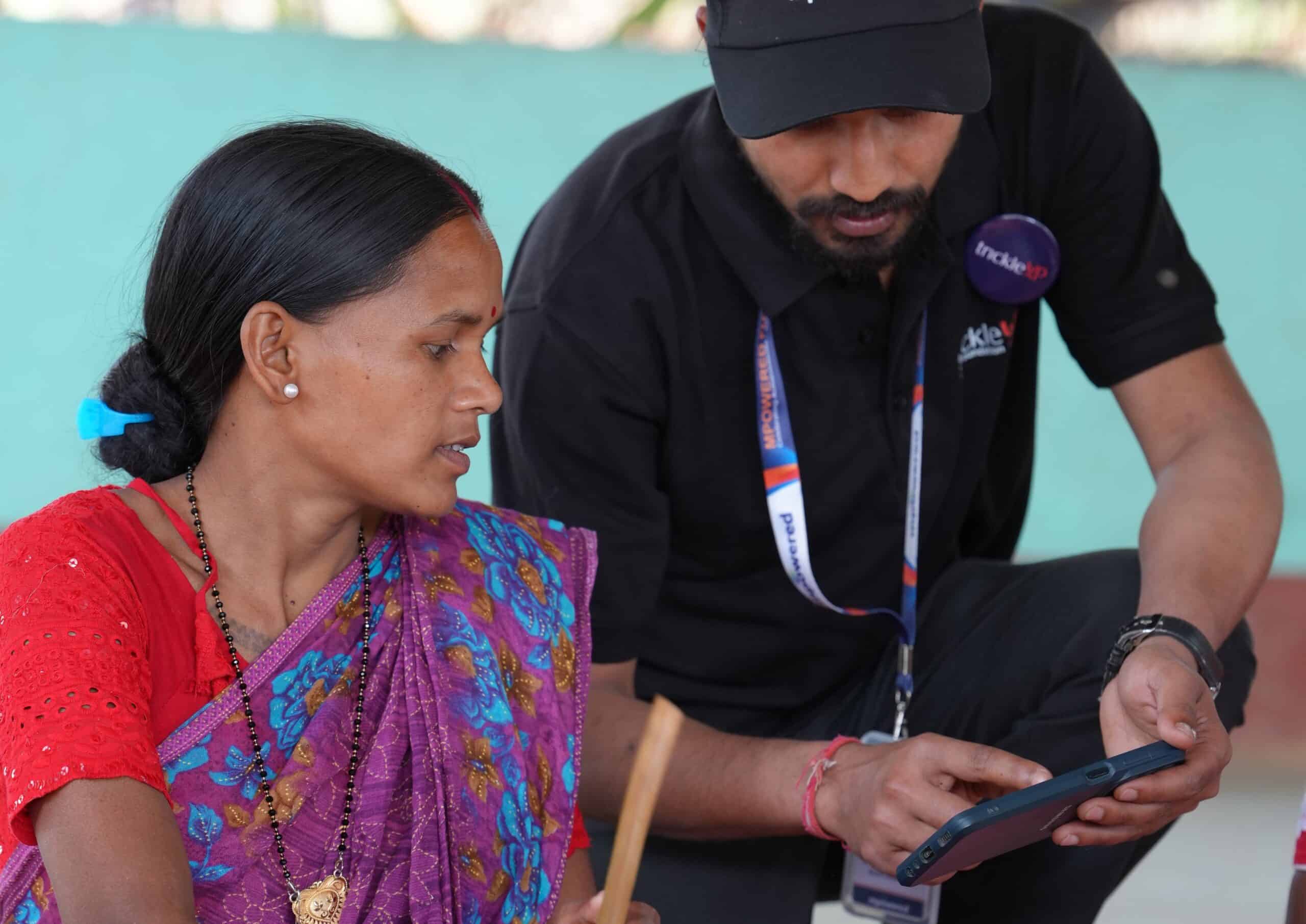
At Trickle Up, this informs the development of our digital ecosystem. Through initiatives such as Coach Up and our emerging WhatsApp-based Chat Up initiative, we are exploring how technology can better support both frontline coaches and program participants.
Our aim is not to replace the human relationships at the heart of economic inclusion programming, but to make those relationships more effective, informed, and sustainable.
Shaping the Future of AI in Economic Inclusion
The “Tools in the Field” session reinforced the value of sharing experiences across the development sector. No single organization has all the answers, and learning from one another can help us make more informed decisions as we explore new technologies.
For Trickle Up, several considerations will continue to guide our approach:
- Start with the problem, not the technology. Digital solutions should respond to real challenges faced by participants and frontline practitioners.
- Look beyond engagement. Digital innovation should contribute to meaningful improvements in people’s livelihoods.
- Design around people’s needs. Technology should be accessible and relevant to the contexts in which people live and work.
- Build responsibly and collaboratively. Localization, data protection, continuous evaluation, and shared learning are essential for sustainable innovation.
- Keep people at the center. Technology should strengthen the relationships and support systems that underpin economic inclusion.
As AI continues to evolve, organizations working in economic inclusion have an opportunity to rethink how support is delivered. At Trickle Up, we see technology as a way to strengthen the work of frontline coaches and extend support to participants, not replace the human relationships at its core. Ultimately, AI’s value will depend on how well it responds to people’s needs and contributes to meaningful improvements in their economic opportunities.