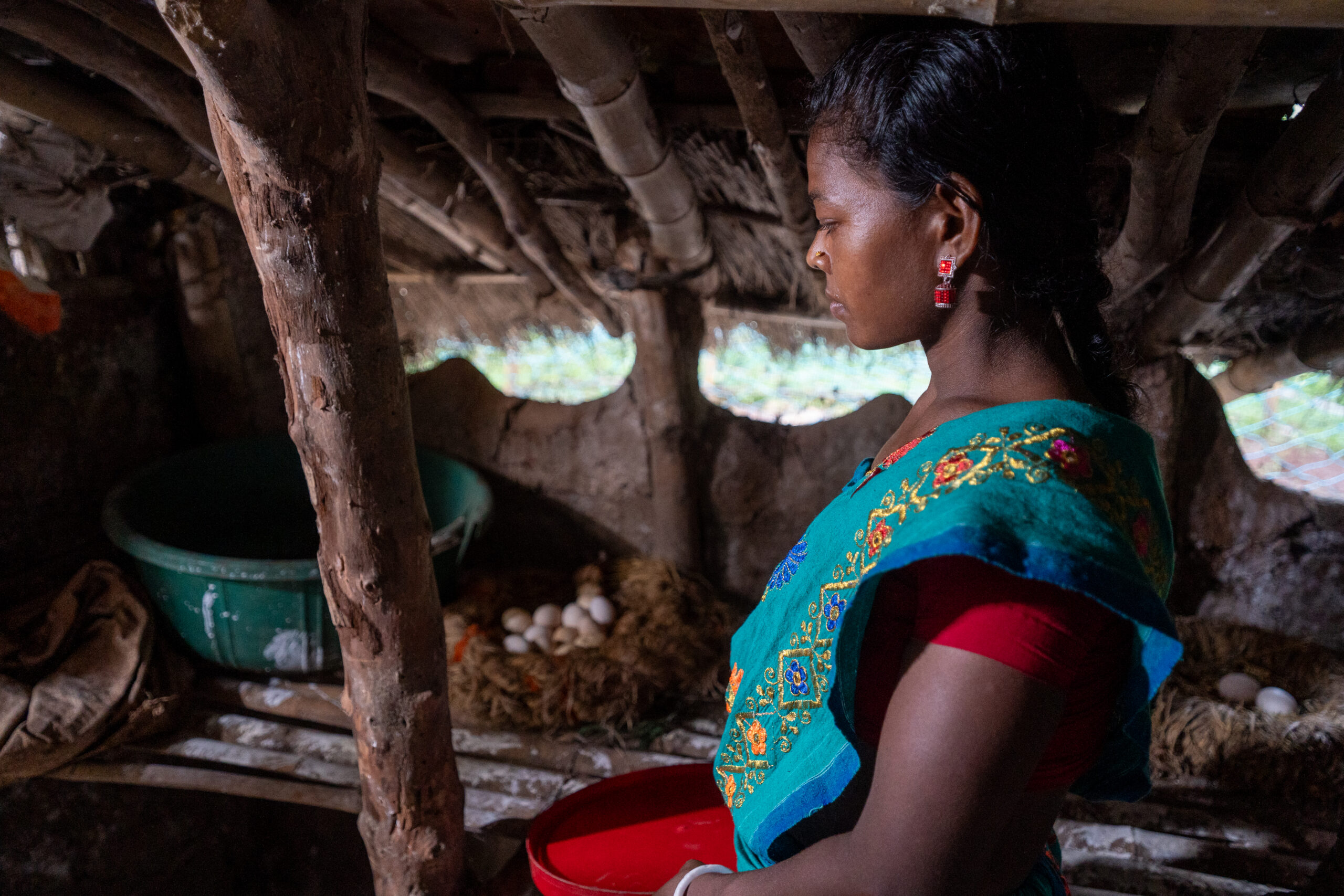
Suddenly losing her husband seven years ago left Sugiya Devi to raise four children, including a baby barely a year old. She had little choice but to take up daily wage work, earning around Rs. 300 (~$3.20 USD) a day and barely making ends meet.
Her family suggested starting a small shop, but Sugiya was unsure whether she could manage it. A Samuday Sathi (an economic inclusion coach) working under the Ultra-Poor Responsive Panchayat (UPRP) program helped her explore livelihood options based on her circumstances, skills, aspirations, and the resources available to her. Sugiya chose goat rearing and agriculture.
She received coaching, training, along with Rs. 30,000 (~$319 USD) through her self-help group (SHG) to support her goat enterprise. A Pashu Sakhi advised her on animal health and vaccination. Sugiya also leased land to expand her cultivation to grow vegetables for the market.
Sugiya’s experience tells us something important: economic inclusion is not simply about providing an asset or helping a household start an enterprise. It is about building the relationships, community institutions, and support from social groups and local government that enable people to make choices, access opportunities, and sustain their progress.
The Importance of Looking Beyond the Household
Economic inclusion programs help families build confidence, develop livelihood plans, acquire productive assets, and improve access to finance and markets. For Sugiya, goat rearing requires veterinary care; agriculture depends on water, land, and inputs; and selling produce requires access to markets.
The UPRP program showed how external challenges can undermine these efforts. Sugiya’s chicks were attacked by dogs, while a neighbor’s vegetable plot was damaged by stray cattle. The program could not adequately address such challenges, but the evaluation suggests that community meetings and locally agreed-upon norms could help prevent similar setbacks. The evaluation also highlighted constraints in Panchayat resources and their limited ability to mobilize funds for diverse livelihood needs. Together, these findings reinforce the need to complement household-level support with stronger, more responsive local systems—but what does that look like?
Bringing the Poorest into Local Decision-Making
Local governance institutions, including Gram Panchayats, Gram Sabhas, self-help groups, and women’s collectives, enable access to public services, entitlements, and development priorities. Yet women from marginalized communities often lack the information or confidence to participate. The UPRP program addressed these barriers by identifying vulnerable households, supporting their participation in Gram Sabhas, and connecting them with Panchayat services. Across the four Gram Panchayats covered by the 35-month pilot in Jaridih block of Bokaro district, participation increased from 40.1% to 74.3%.
However, only 11% of participants felt confident speaking freely in public. Participation does not necessarily mean influence. Meaningful participation means being able to raise concerns, influence decisions, and see them acted upon. SHGs and women’s collectives can help women build confidence and a collective voice, while Samuday Sathis bridge the gap between households and local institutions. But the responsibility cannot rest with women alone; local institutions must also become more open, responsive, and accountable.
Institutions Matter, But So Do the Relationships Between Them
As we’ve explored in recent conversations focused on partnering with municipal governments in Guatemala and faith-based institutions in Cote D’Ivoire, local institutions are critical to the relevance and sustainability of economic inclusion programs. However, strengthening local systems requires more than supporting individual institutions. It means understanding the interdependencies between institutions and communities and how they can work together.
In India, for example, the Gram Panchayat is only one part of a broader local governance ecosystem that includes SHGs, women’s collectives, community forest institutions and Water User Associations. Despite working on interconnected issues, these institutions often operate separately. A household’s livelihood may depend on access to common land, forests, water bodies, or pastureland, but decisions about these resources do not always fall under the Gram Panchayat’s authority.
This is particularly relevant in areas where laws such as the Panchayats (Extension to Scheduled Areas) Act (PESA) and the Forest Rights Act (FRA) provide frameworks for community participation and resource governance. Strengthening local systems means connecting these institutions while ensuring communities have a meaningful role in decisions affecting their livelihoods.
From Participation to Institutional Responsiveness
Strengthening local systems means more than helping people access existing institutions. Those institutions must also respond to the needs of the people they serve.
In the UPRP program, Samuday Sathis connected households with Panchayat help desks, SHGs, and government programs. They visited families, listened to their aspirations, and helped them navigate local institutions.
One Samuday Sathi from Bhaski Panchayat captured the human dimension of this work: “A human being needs a companion more than anything else. Our widowed didis carry their pain alone. Nobody has time to listen. Through this work, they found a companion. That is what made the difference.”
This shows how institutional strengthening is also about trust, relationships, and empathy. The Samuday Sathis themselves experienced personal and professional growth through their work. Asha Devi, a Samuday Sathi, expressed her thoughts on Sugiya: “I get inspired by Sugiya Didi. Whenever I feel tired, I think of her.”
Their relationship goes beyond that of a program worker and participant. Both learn and draw strength from each other.
From Project-Led Support to Locally Owned Systems
Development programs often create temporary structures to deliver services efficiently when existing systems are weak or inaccessible. However, these structures may not last beyond a project’s life. For economic inclusion to be sustainable, the long-term objective must be to strengthen existing institutions that can continue supporting communities after a project ends.
This means investing in existing local institutions and resource persons, improving Panchayat responsiveness, and creating stronger connections between households and institutions. It also requires supporting local institutions to identify community priorities, incorporate them into plans, mobilize resources, and remain accountable for results.
The Real Change
Sugiya Devi’s progress is visible in the goats she has raised, the vegetables she now sells, and her confidence in making decisions about her future. These achievements depended on a network of support: a Samuday Sathi who listened and helped her plan, a Pashu Sakhi who provided technical advice, an SHG that enabled access to credit, and public programs that provided social protection.
The success of an economic inclusion program cannot be measured simply by the number of households supported, assets distributed, or enterprises started. We must also ask whether local institutions are more responsive, whether women have a stronger voice in decision-making, and whether support systems will continue after the program ends.
When that happens, economic inclusion moves beyond individual households. The poorest become not merely recipients of development, but active participants in shaping their futures and their communities.
Sugiya’s story, both her progress and her struggles, reinforces why Trickle Up’s role goes beyond supporting individual livelihoods. By facilitating connections, strengthening local systems, and helping communities and institutions take ownership, we can contribute to local systems that continue supporting women like Sugiya long after a project ends.