
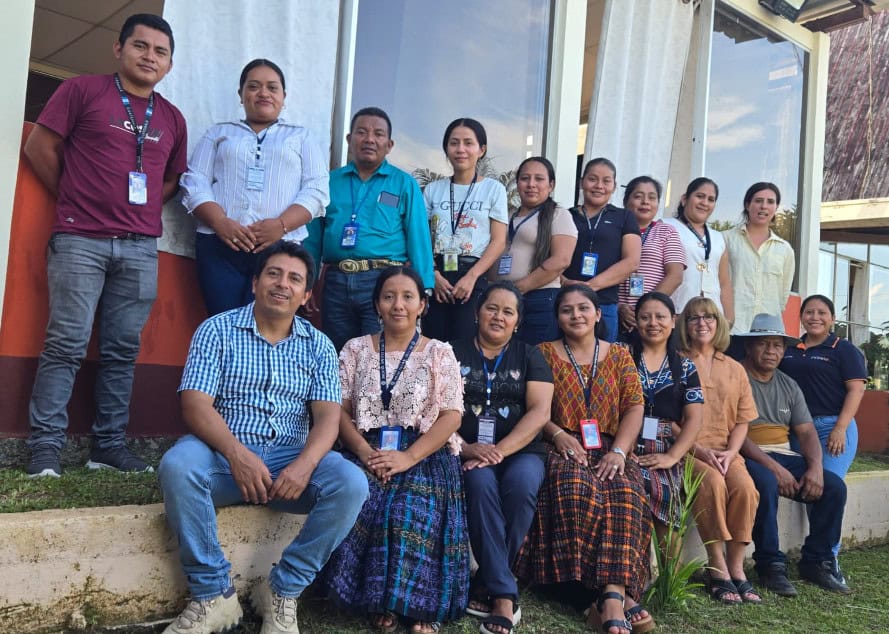
During my recent visit to Guatemala, I sat down with a group of economic inclusion coaches in Ixcán. What impressed me most wasn’t simply their knowledge of Trickle Up’s Graduation Approach or their technical expertise, but how well they knew the women they supported. They spoke about the women with genuine affection and pride, understanding each woman’s circumstances, challenges, and progress. It was clear that their success mattered deeply to the coaches.
At the same time, these coaches were consummate professionals, working out of municipal government offices and closely integrated with local leadership, including the mayor and the head of the municipal women’s department. They weren’t an external project team working alongside the municipality; they were part of the institution itself, with salaries paid by the municipality.
For me, these coaches represented something that the international development sector talks about frequently but doesn’t always achieve: genuine local ownership.
When Local Commitment Goes Beyond Words
During my visit, I also met with the mayors of Ixcán and San Pedro Carchá, two municipalities partnering with Trickle Up to bring economic inclusion opportunities to women living in extreme poverty.
Both mayors knew the programs and the municipal staff implementing them well. Rather than making ceremonial appearances, they were engaged, informed, and clearly proud of what their municipalities were accomplishing.
Both were also enthusiastic social media users, filming and livestreaming throughout our visits—even during informal lunches. It was amusing, but also revealing: they wanted their constituents to see exactly what their municipal governments were doing. They viewed economic inclusion as an important service they were delivering to their communities.
This commitment goes beyond political support. In Ixcán and San Pedro Carchá, municipal governments invest their own resources to make these programs possible, paying coaches’ salaries, providing office space and transportation allowances, and contributing to the productive assets women need to establish or strengthen their livelihoods.
For every dollar Trickle Up invests, our municipal partners invest $1.50. This is a powerful demonstration of local commitment. These municipalities aren’t simply hosting an international NGO’s development project; they’re investing in their own communities and taking responsibility for delivering economic inclusion programs to some of their most vulnerable citizens.
Trickle Up provides the technical expertise, methodology, training, and ongoing support, while municipalities contribute the leadership and financial resources to deliver these programs.
Building Programs That Outlast Elections
One of the greatest challenges in international development is ensuring that successful programs continue after a project ends, donor funding changes, or a new political administration takes office.
This is why I was particularly encouraged to learn that Ixcán has taken steps to embed its economic inclusion program into municipal public policy. Importantly, the program’s budget allocation is approved by the Municipal Council, demonstrating that support extends beyond the mayor’s office to the broader municipal government.
A recent Trickle Up-commissioned study of our municipal partnerships in Ixcán and Chahal reinforces this point. It found that long-term sustainability depends not only on political will and financial resources, but also on strong local institutions, community ownership, and embedding economic inclusion in municipal systems. By integrating economic inclusion into municipal priorities, staffing, and budgeting, Ixcán is helping create the conditions for it to endure across political transitions.
Of course, no policy or budget allocation can guarantee that a program will survive every change in government, but building institutional support that extends beyond any one elected official is an important step toward lasting sustainability.
Scaling Graduation from the Ground Up
These experiences also raise a larger question about how we scale economic inclusion. Across the global Graduation community, there is growing interest in working with governments to bring proven approaches to scale. Much of that work understandably focuses on national governments, which can reach millions of people through social protection systems and other public programs.
But my visit to Guatemala reinforced the importance of scaling through local governments, too. Municipal governments are close to the communities they serve, understand local economic opportunities and challenges, and can build long-term relationships with participants, as I saw with the coaches in Ixcán. They can also mobilize their own public resources to invest in economic inclusion.
This approach isn’t without challenges. Local governments vary in their financial resources, technical capacity, and political commitment, and successful partnerships requires patience, trust, technical assistance, and a willingness to adapt programs to local circumstances.
But what if scaling didn’t require an international NGO to expand its own operations at the same rate as the number of people it reaches?
In Guatemala, Trickle Up’s investment is helping mobilize additional municipal resources and strengthen local capacity, while municipal employees deliver programs directly to their communities. This offers a way to expand economic inclusion without growing our own implementation infrastructure at the same rate—and to leave lasting delivery capacity within local institutions.
Imagine what could be possible if dozens, or even hundreds, of municipalities adopted this approach.
A Different Vision for Scale
For Trickle Up, these partnerships represent an important part of our vision for the future. Across Africa, Asia, and Latin America, we see tremendous opportunities to work with governments at different levels to expand economic inclusion. In some context, that means supporting national governments and social protection systems capable of reaching millions; in others, it means partnering with municipal and local governments to build programs responsive to their communities’ needs.
These are not competing approaches, but complementary pathways to sustainable scale.
Both require us to rethink the role of international development organizations. Our ambition should not simply be to implement more projects ourselves, but to strengthen the institutions and systems that allow economic inclusion programs to grow and endure, with governments and communities taking the lead.
When I look at the photograph of the municipal coaches in Ixcán, I see more than a group of dedicated professionals helping women build better livelihoods. I see this vision in practice: local governments investing in their communities, professionals who know and care deeply about the people they serve, and an international organization providing the expertise to support their success.
Perhaps our greatest measure of success won’t be how large Trickle Up becomes, but how many local institutions we equip to create lasting economic opportunity for the women and communities they serve.